Sunday, 7 June 2009


GREETINGS TO ALL MAD TOY SOLDIER COLLECTORS WHEREVER YOU MAY BE!
Bit of a mixture this time and a chance for me to catch up on some ongoing and perhaps neglected projects.
I have always wanted to add limber teams to tow my guns, rather than having to imagine them being dragged along by invisible horses and drivers, or even worse by some strange earth force that dates back to ancient times when people painted themselves rather than toy soldiers. The French Napoleonics are reasonably well catered for with two Italeri sets, which although of some inaccuracies are pretty good material, however there is nothing for the Brits or other nationalities, so I decided to make a 4 horse team that I could use for the Napoleonic War, The War of 1812, The Crimea and anything else in between. So far it has been a labour of hate, but with some useful learnings on the way. The first two photos show the (nearly) completed drivers and their mounts. The men are simple adaptions from HELMET spares, nothing really special about them, however the horses were the real problem. The third picture shows construction of the four horses before painting, as you can see I did head swaps on the driver's horses, and also a tail swap on one for a bit of variety and to use heads that had moulded reins. Much of the simplified harness uses milliput and/or greenstuff, but my real problems arose from my opting to use decorative gift wrapping tape for the main strapping. My (obviously logical) reasoning being that this was pre-cut- although I had to cut it in half lengthwise, as it was too wide - so I would have to do less tedious cutting, secondly I chose the metallic type as I knew this to be stronger.
Alas dear reader I could not find a glue that would stick the damn stuff to the plastic of the horses. Super glue wouldn't touch it, I spent a whole evening, the air rent with numerous foul expletives, sticking my fingers together and to the horses, even when I thought I had achieved success as soon as I put the ****ing thing down, the joints slowly and provocatively slid apart, cue more swearing. Eventually I used a contact adhesive and a couple of coats of strong varnish. Learning Point? "Check what glues will work on the proposed materials before construction work begins, and try not to swear too much in the course of what should be an enjoyable hobby."
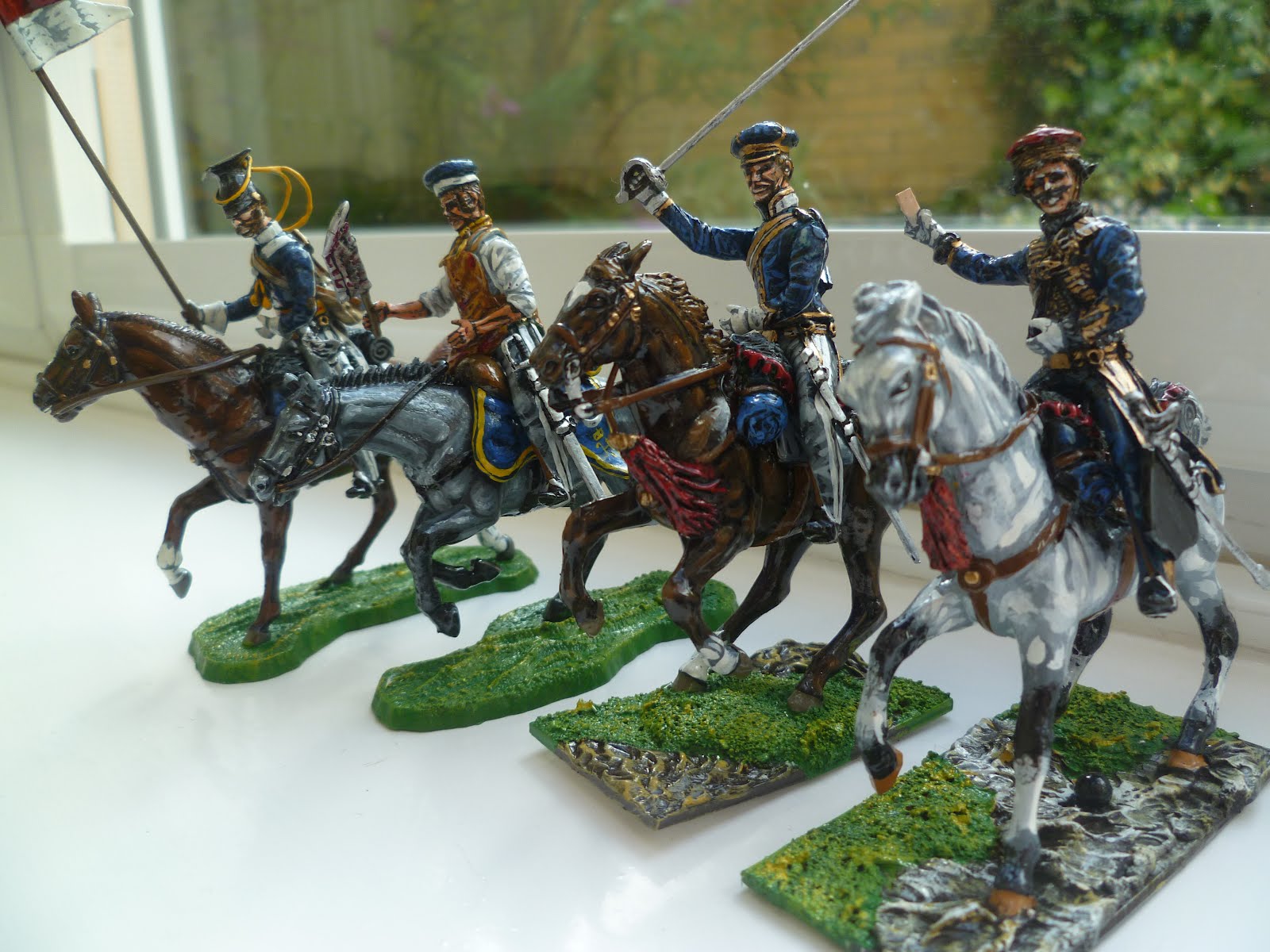
The fourth picture is a better photo of two of our new Prussian Hussar kit, it and the Uhlan should be up on the website this week - please spend generously.
Lastly a picture of some more of my War of 1812/ Peninsular War British Infantry, these are made from a variety of bits see if you can guess the source. Ken C this means you!
That's all, next time some more Napoleonics.
Take care, play fair and keep your powder dry.
Eric

Monday, 1 June 2009


Greetings to one and all.
This edition of the Blog is a shameless attempt at generating income for HELMET Soldiers and shows some stuff I'm currently working on.
I would be really grateful if people who read this could post comments and suggestions, I want to make HELMET a success and the only way I can achieve this is through satisfying my customers.
Not much writing this time around, hopefully the pictures will tell their own story, however the photos were taken on Saturday afternoon during what alarmingly seems to have become a British summer, so they are a tad bright, apologies for that and sun glasses are recommended!
First up is one of our new hand made accessories, an archers' mantelet, this and a couple of other pieces are now for sale on the website are ridiculously low prices. www.helmetsoldiers.co.uk
Next the first in a range of 54mm/1:32 flags. These are for the 1st Footguards at Waterloo. They come on the same sheet with a cavalry standard as bonus and will retail at 2 GBP plus postage. We previewed these at the Plastic Warrior Show in Richmond, and actually sold some! They are not computer generated, but I paint them in watercolours at twice full size. I have completed a sheet with 8 Parliamentary cavalry standards from the English Civil War, and am working on French flags for 1815, they all should be available shortly.
Lastly there are two photos from a projected range of allied cavalry for the Napoleonic period, first to see the light of day will be the Uhlan followed soon by the Hussar as shown here. We are also working on a new body ( aren't we all?) so that we can produce Dragoons, Cuirassiers and Landwehr cavalry. More news soon.
Ant reaction/comments gratefully received.
Cheers
Eric


Tuesday, 31 March 2009


These Blogs are coming along in threes, just like London Buses........
As promised I attache some pictures of the painted Winged Hussar along with some WIP photos of the second member of this mad project.
So I decided that I just had to have some Polish Winged Hussars and my addled brain began to process the potential difficulties of obtaining and converting suitable figures, the problems resolved themselves onto three main areas:
1. A mounted figure to use as a basis.
2. How to make and fix the wings
3. Weaponry - of which there is quite a lot.
Taking those in order, the obvious starting point foe the figure is a mounted Knight isn't it? Well I certainly thought so, they've got armour and are in the right sort of position. Therefore I got some cheap bits via ebay, and stated to study the Osprey book on the subject, and guess what, even if you want to produce a rough approximation of Polish armour you need to almost completely re-sculpt the armour. The two top pictures show this as well as the ones in the previous Blog, all I was left with was the top half of the cuirass, the rest is Milliput or Greenstuff. I used a lot of Milliput as the weight counters the top-heaviness of the completed model. The heads are from Maros in both cases. The clothing, what you can see of it and the animal skin are from Greenstuff, it all took a long time.
I pondered long and hard over the wings, and discarded a number of options before settling on this solution. The Osprey source shows that in the 1680's they were attached to the rear of the cuirass not by a series of straps as I had imagined also they were (obviously I guess) very light, so these are made from thin copper tube carefully bent to shape, with feathers from thin card fixed with impact adhesive. The feathers for each wing are made in one piece, I had thought to make individual feathers, but luckily a shaft of common sense hit my brain and things were made slightly easier. The wings are attached to the figure by sliding the copper tubes over pins that are fixed and then bent at right angles so they are vertical, this can be seen in the first pic above. A bonus of this method is that the wings can be removed and packed away as they are quite fragile.
Weapons, this started well and ended badly. The sabre if from HELMET spares as are the pistols attached to the front of the saddle, the pained model also uses our pistol holsters, the lance is brass and the pennon from painted paper. So far so good, then disaster...... The painted fig should have a long straight sword slung from the saddle under the left thigh, I just couldn't get one to fit as I left this part much too late, When I started the second model, this was one of the first jobs I tackled, see photos above - the blue feet by the way are there because on completing the armour I noticed that the Britains knight no longer looked right, mainly because one leg was about 8mm longer that the other, so major amputation and transplant surgery was necessary.
So main lessons were, research the basis figure well before spending money and starting converting, be clear from the outset how to construct the various components, and lastly make sure everything will fit together in the right order to avoid last minute frustrations.
Next I'll complete the WIP figure and make perhaps one or two more and then think about producing some Turks by way of opposition, then more War of 1812???
Comments and feedback welcome
Cheers
Eric

Monday, 30 March 2009


I guess I should entitle this Blog as "An Attack of Madness, tempered by a Return to Common Sense".
The Story So Far......................
So I got interested in the late 17th Century and started to convert some figures for the Monmouth Rebellion with a view to perhaps using them in other conflicts, such as against the Moors at Tangier and in Europe or Virginia etc etc. I found a terrific Blog which has fuelled my enthusiasm and extended the possibilities that this period can deliver, if you are at all interested click on the link http://warsoflouisxiv.blogspot.com/ it is an example of some of the better thing that the Internet has produced.
So there I was looking at wars in the 1680's when I sort of remembered the siege of Vienna in 1683 (?) and the charge of the Polish Winged Hussars, so I checked my books and found some info, but not in any great detail, I searched the web and found some more pictures and film clips, both movies and re-enactment footage, then I bought, secondhand, the Osprey book on Polish Winged Hussars, the red mist descended and I had to have a go, so the first two pictures show my first attempt, with the converting finished but the painting yet to be done. I will describe how I built this beast, what went well and what went wrong, next time...................
The next two photos show how I built some of the musket armed figures shown in the previous Blog, with another pic here as a reminder. In actual fact these two chaps are the first of my Monmouth Rebels, the construction principles remain the same, however. These two are from the Accurate AWI Militia set. I chose them for a number of reasons:
* They both have flintlocks - apparently Monmouth was fairly well supplied with these.
* They are wearing long coats, which although of the wrong design can be easily adapted to reflect the style of the 1680's.
* They are wearing breeches and stockings, so no work needed there.
They both needed to have different headgear, the one on the left had his hat cut off at forehead level and a new on added, the brim is Milliput, a flattened ball of the stuff pressed onto the flat surface left after cutting, the rest of the hat was built from greenstuff, all very simple. His colleague has a metal head made by Maros. The plastic head was removed and a hole drilled in the neck to take the metal stub on the Maros head, after a dry run to make sure everything fitted the new head was fixed with superglue. When this has dried I added a neck cloth from putty, this is historically accurate and adds strength to the join and covers any gaps.
The rest was comparatively simple the coat fronts, pockets and cuffs were fixed with Milliput, the weight of this material compensates for the top heavy metal head, and the buttons gradually built up with thick paint.
I trimmed the cape from one of the coats and also trimmed off the powder horn and made a more in-period powder flask, finally I added some greenery in the hats, which Monmouth's men used as a sort of fieldsign/badge.
That's it, next time it's the Hussar.
Cheers and take care.
Eric

Monday, 23 March 2009


This Blog is as regular and reliable as good news in the economy.

Apologies once again for the erratic and irregular postings, this has been mainly due to two factors, once again I have been made jobless, that is my normal full time employment has been "terminated due to the current economic situation", and secondly, I have had what my doctor still, with that knowing little piece of humour that endears the profession to the rest of us, the 100 day coughing virus, which leaves me feeling, well, pretty crud.

So I have been job hunting and trying to get well. Simultaneously I have embarked on yet another new period, focusing initially on what is generally known in the UK as the Monmouth Rebellion. Very briefly, this was an attempt in 1685 by the illegitimate son of Charles II, James Duke of Monmouth to bring about regime change and topple his uncle, King James II. Activities were centered in the West Country and ended after a brief campaign at the Battle of Sedgemoor where Monmouth and his army were defeated.

I chose this period because I find it of great interest personally and it is another "little war" that lends itself to re-creation in 54mm scale and there is a surprising amount of information available on the uniforms colours and organisation of the protagonists, finally the regulars as seen in these photos can, I hope be used in other theatres such as Tangier against the Moors and in Europe against the armies of other nations.

What we show above represents a company of Kirke's Regiment from the army of James II, they are mostly produced by converting A Call to Arms ECW figures, although there are some AWI models from Accurate and ECW from Replicants. Next time I will explain how the conversions were achieved and also mention some useful sources including a truly inspirational Blog which anyone interested in the period should follow.

In the meantime feedback welcomed and see you soon.

Cheers

Eric

Sunday, 4 January 2009


Hi to everyone, and a happy New Year to you all.
We have had yet more technical issues so this edition has been delayed somewhat, however, here is a brief glimpse of the wargame we started on Boxing Day.
We don't get the chance to fight many games, and up until now the rules that we have made up and used resulted drawn battles and unrealistic carnage, especially annoying having spent hours painting the figures and see them blown away in seconds. So I wrote a new set, what we wanted was rules that were simple, but realistic and made us behave in ways that encouraged 19th century tactics, so far we are reasonably pleased with them, but it's early days.................
So we used all our War of 1812 figures, the British number 70 Regulars with a dozen Riflemen and a foot artillery gun, the Americans had 88 Regulars including 12 Rifles plus 4 cavalrymen and 10 Militia and a gun with crew, The scenario was set around the need to capture a cross roads with the redcoats defending and the Americans attacking in two columns. The first two pictures show some of the defenders lining a fence and occupying a ruined cabin. The idea behind these Brits is to also use them in Peninsular War battles, as soon as Hat release their forthcoming French light infantry.
The long haired kid is my son, Jonny, here commanding the US forces with more dash and aggression than normal. The last two photos show the two American attack columns the first is a mixed force of Regulars, Marines and Militia, the second is made up of two complete companies of the 18th Infantry following their colours and general.
The first few moves saw the US artillery consistently miss it's targets, and the boldly advancing Militia fire a volley and then retreat with alacrity! The US Regulars met with greater success, and although taking casualties as they advanced (our new rules say that no-one can move and fire in the same move - so you have to take calculated risks around gaining ground or causing casualties) forced the British Riflemen to retreat and threatened to outflank the British line.
More next time
Cheers
Eric


Sunday, 7 December 2008


Hello again to all those out there in toy soldier land, here we go with another Blog. Before I describe the pictures I'd like to mention a couple of points. Firstly a huge thank you to all those who mailed in comments after the last Blog, they were a good mix of the positive and the critical, and hopefully I shall bask in the glory of the former and reflect and take action on the latter, as I said I'd like this to be as interactive as possible, so please write in.
The second item is a reflection on the current state of our hobby. As HELMET Soldiers we attended the London Toy Soldier Show yesterday, and although attendance was good our takings were very poor and all the other dealers I spoke with had a similar experience. There were plenty of orange carrier bags around so hopefully Steve Weston had a good day, however the cost of hiring two tables, and paying for petrol and car parking meant that we barely covered our costs, I guess we'll have to have a good long think about the number of shows we plan to attend in 2009, but we won't be giving up yet.
Some of the feedback I received last time asked for a more detailed description of the conversion, so I show a photo of a completed American Militia officer, War of 1812 vintage, prior to painting. The tools and equipment used were a sharp hobby knife, some brass wire, superglue, a small electric drill ( not critical but very useful) and greenstuff modelling putty. I chose a Replicant mule handler as the basis for the conversion and did the following nasty things, cut off his head and left hand and removed the whip from his right. I carefully re-carved two small sections of fringing after the whip had gone, and drilled a hole through the hand where the whip had been big enough to take a musket, and, as it's best to complete all fixing first, I also drilled a hole in the neck and the left wrist.
The new head is from a CTS Mexican round hat cavalryman, and the hand holding the pistol is off an Accurate American Revolution militiaman. These are then drilled in the neck and wrist respectively to take short lengths of brass wire. As this type of plastic is technically unbonbable as there is no solvent, joins have to be pinned and glued, so the new head and hand are fixed to the superglued wire and pressed home firmly. I the glued a HELMET French musket into the hole in the right hand. I then set the figure aside for the glue to set.
Next I mixed a small amount of putty. Greenstuff comes in yellow and blue strips and must be mixed to a consistent green colour to become a sticky putty. I wrapped two short sausages of the stuff one around the neck and the other around the left wrist, I then sculpted a new collar and cuff to the hunting shirt, this also strengthens the glued join. I put a blob of putty on the crown of the hat which I carved to the shape of a top hat with the side of my knife, and made a cockade on the left hand side with a tiny flattened ball of greenstuff, I made a sash with trailing ends and a knot from a "snake" of putty and carved in creases and fringes with my knife. Finally I added a pouch on his right hip from a short crossbelt all out of putty although the photo does not show this clearly, the picture does show all the different parts including the greenstuff, believe it's much easier to describe than to do.
OK, a quick romp through the other photos. First some English Civil War dragoons from Replicant and ACTA pieces converted pretty much as above but with new metal muskets instead of plastic.
Next some Napoleonic British marines, I have a habit of prequelling new release by laboriously converting stuff just prior to someone releasing some in ready made form and these are another example, The officer is the old Aifix figure with missing crossbelt replaced and a new Timpo head, the next two are Replicant Austrians with new heads and slight changes to uniform details, the last ids the old Replicant marine firing upwards, altered to a more normal firing position by cutting at the waist and re-fixing at a different angle ad resculpting the jacket and crossbelts in greenstuff.
Finally some French Old Guard. The first four from the left are metal figures from Irregular, in my opinion, (FWIW) I think these are great models, all I've done is add a bayonet to the fourth man from the left. They are joined by two from the slightly disappointing set by Airfix with full dress plumes and cords added to the bearskins to match the Irregular models.
That's all for now, all comments, questions and feed back encouraged!!!!
Cheers
Eric